
Full funnel marketing healthcare is a coordinated, multi-stage patient acquisition system that applies awareness, consideration, and conversion-stage strategies across digital channels – with every tactic designed within the strict compliance boundaries of HIPAA’s Privacy and Security Rules, which prohibit using Protected Health Information (PHI) for marketing purposes without explicit patient authorization and require a signed Business Associate Agreement (BAA) with every vendor that creates, receives, maintains, or transmits PHI on behalf of a covered entity. The patient journey in healthcare is distinctly longer and more trust-dependent than conventional B2B or B2C funnels: patients compare an average of 21 provider profiles before booking, 79% read online reviews before choosing a provider, and 47% now use AI tools to research physicians – meaning healthcare organizations that invest only in bottom-of-funnel conversion tactics are missing the awareness and consideration stages where the majority of provider selection decisions are actually made. Building a compliant, revenue-attributed full funnel marketing healthcare strategy requires four foundational elements: a PHI-safe data infrastructure with BAA-covered analytics, a patient education content architecture at the top of the funnel, a HIPAA-compliant nurture system in the middle, and conversion-optimized appointment booking experiences at the bottom – all measured against patient acquisition cost and lifetime patient value rather than raw lead volume.
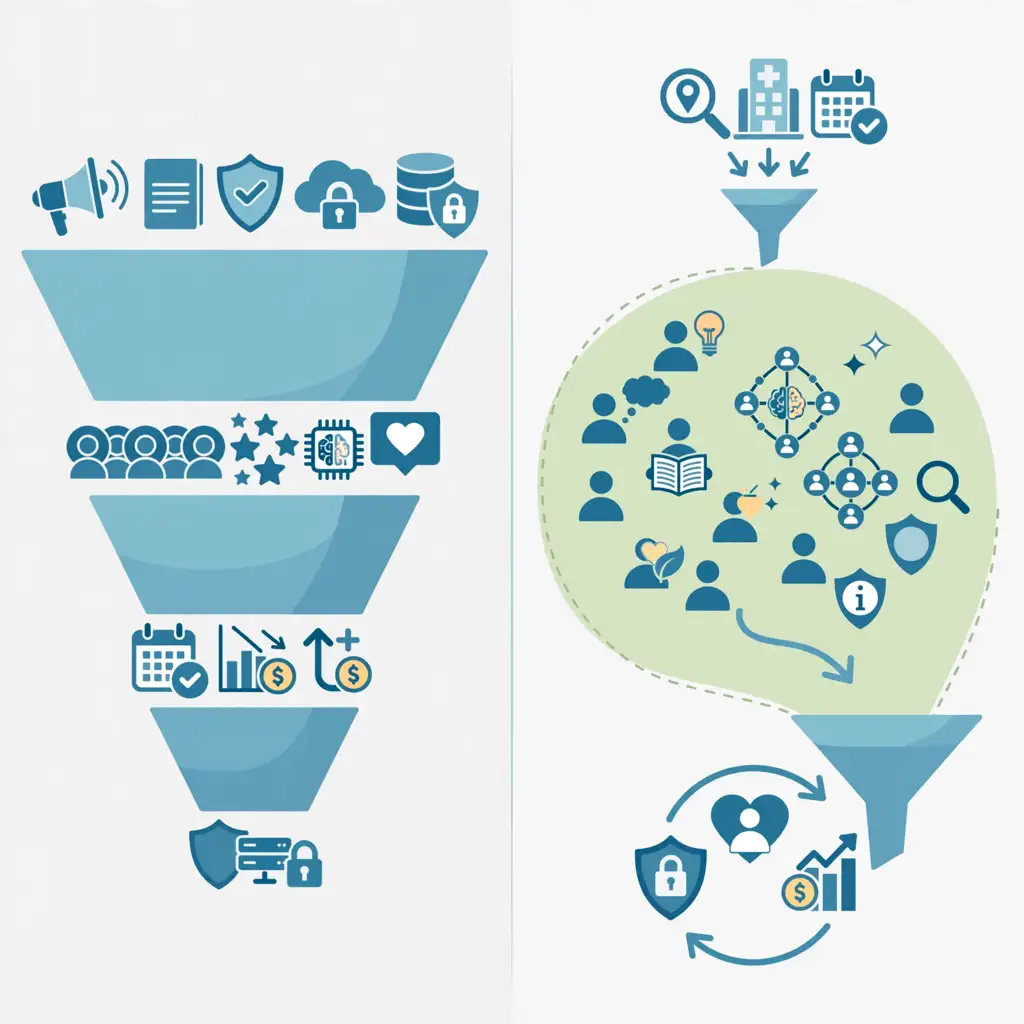

Most healthcare practices invest the majority of their marketing budget in the last mile: Google Ads for appointment searches, a basic website, and perhaps a directory listing. These tactics compete only for patients already in active provider search – the estimated 5% to 10% of your total addressable patient population that is in-market right now.
The remaining 90% are forming health opinions, developing symptom awareness, building provider familiarity, and researching care options through channels that most healthcare marketing programs entirely ignore. Full funnel marketing healthcare closes that gap systematically – and does so within the compliance requirements that make healthcare marketing uniquely complex.
Organizations that want to explore how a patient-centric, HIPAA-aware full-funnel revenue marketing framework connects digital acquisition strategy to verifiable patient acquisition outcomes can use BRMIS as a strategic reference point for compliant, full-funnel execution.
What is Full-Funnel Marketing in Healthcare? (Definition)
Full funnel marketing in healthcare is a patient acquisition and retention strategy that addresses every stage of the patient decision journey – from initial health awareness through provider research, appointment booking, first visit, and ongoing care relationship – using channel-appropriate tactics that comply with HIPAA and applicable state healthcare advertising regulations.

Quick definition for featured snippets:
Full funnel marketing healthcare is a coordinated digital strategy that guides potential patients from problem awareness through provider selection to booked appointment, using HIPAA-compliant content, advertising, and nurture tactics at each stage of the patient journey.
Healthcare marketing differs from conventional demand generation in three critical ways:
- Trust requirements are higher: Patients are making decisions about their physical health, not software subscriptions. Every marketing touchpoint must communicate clinical credibility, empathy, and trustworthiness before conversion intent can develop.
- Compliance constraints are binding: HIPAA’s Privacy Rule and Security Rule impose specific restrictions on how patient data can be collected, stored, and used in marketing contexts. These are not optional best practices; they are legal requirements with penalties ranging from $100 to $50,000 per violation incident.
- The decision timeline is non-linear: Patients research health conditions for weeks or months before actively seeking a provider. Marketing that only activates at the moment of active search misses the extended awareness and consideration phase where brand preference is actually formed.
The Healthcare Patient Journey: Understanding Each Funnel Stage
The patient journey in healthcare maps closely to the classic marketing funnel, but with stage-specific characteristics unique to healthcare decision-making.
Stage 1: Awareness (Top of Funnel)

Patient state: The patient is experiencing symptoms, a life transition, or a general health concern. They are not yet searching for a specific provider. They are searching for information about their condition, treatment options, or general health guidance.
What patients are doing at this stage:
- Searching for symptom information and condition explanations
- Reading health content on websites, blogs, and social media
- Watching health-related videos on YouTube
- Listening to health podcasts and following health accounts
- Asking questions of AI tools like ChatGPT or Google’s AI Overview
Marketing objective: Create brand familiarity and educational authority before the patient begins active provider search. Establish your practice or health system as the trusted source of information for the health topics relevant to your specialty.
HIPAA implication at this stage: Minimal – patients have not yet provided any personal health information. Standard web analytics and advertising targeting using demographic and interest-based data (not health condition data) are permissible without a BAA, provided no PHI is transmitted to ad platforms.
Stage 2: Consideration (Middle of Funnel)

Patient state: The patient has identified a health need and is actively researching care options, treatment approaches, and provider types. They are comparing specialties, reading about treatment modalities, and beginning to evaluate specific providers.
What patients are doing at this stage:
- Reading provider reviews on Google, Healthgrades, Zocdoc, and Yelp
- Comparing provider profiles and credentials
- Researching specific treatments and procedures
- Watching patient testimonial videos
- Visiting provider websites and reviewing service pages
- Checking insurance acceptance and location
Marketing objective: Establish your practice as the most credible, trustworthy, and relevant option in your service area for this patient’s specific need. Differentiate on expertise, outcomes, patient experience, and accessibility.
HIPAA implication at this stage: Moderate risk. Retargeting patients who visited condition-specific pages or procedure pages can constitute the use of inferred health information. Meta’s January 2025 policy changes proactively scan and disable custom audiences that appear to reference protected health or financial attributes. Google has implemented similar restrictions for healthcare advertising custom audiences. Retargeting must use broad behavioral signals rather than condition-specific page visit data.
Stage 3: Decision (Bottom of Funnel)

Patient state: The patient has identified a shortlist of providers and is ready to book an appointment. They need to resolve final practical objections: insurance acceptance, availability, location, cost transparency, and the friction of the booking process itself.
What patients are doing at this stage:
- Searching for specific provider names or practice names
- Visiting appointment booking pages
- Checking availability and scheduling options
- Reviewing patient portal information
- Calling the practice directly
- Comparing online booking convenience against competitors
Marketing objective: Remove every friction point between provider selection intent and booked appointment. Make the booking process seamless, the availability visible, and the first contact experience trustworthy enough to complete the conversion.
HIPAA implication at this stage: Highest risk. The booking process collects PHI directly. Appointment forms, patient intake systems, and scheduling platforms must operate under BAA coverage. Analytics tracking on appointment confirmation pages can transmit PHI to third-party platforms if not carefully configured.
Stage 4: Retention and Advocacy (Post-Conversion)

Patient state: The patient has experienced care and is now in an ongoing clinical relationship. Marketing at this stage focuses on re-engagement, preventive care reminders, loyalty, and structured referral generation.
What patients are doing at this stage:
- Evaluating their care experience against their expectations
- Deciding whether to return for follow-up or ongoing care
- Forming opinions they may share through reviews or recommendations
- Receiving (or not receiving) post-visit communications from the practice
Marketing objective: Retain patients through proactive, value-added communication; generate positive reviews through structured review request programs; and activate referral networks through patient satisfaction programs.
HIPAA implication at this stage: Very high. All post-visit communications involve PHI. Email, SMS, and patient portal communications must use HIPAA-compliant platforms with signed BAAs. Automated appointment reminders, care gap outreach, and treatment follow-up sequences require both technical safeguards and administrative compliance documentation.
HIPAA Compliance in Healthcare Marketing: The Non-Negotiable Foundation
Before implementing any full funnel marketing healthcare strategy, understanding and respecting HIPAA’s marketing-specific rules is essential. Non-compliance is not just a legal risk – it is a reputational catastrophe. HIPAA violations can cost between $100 and $50,000 per incident, with annual penalties reaching $1.5 million per violation category.


What HIPAA Defines as “Marketing”
Under the HIPAA Privacy Rule, “marketing” means a communication about a product or service that encourages recipients of the communication to purchase or use the product or service. However, HHS provides important exemptions for communications that describe health-related products or services offered by the covered entity, treatment communications, and case management or care coordination.
Communications that require patient authorization under HIPAA:
- Using PHI to target patients with marketing communications for third-party products or services
- Selling PHI to advertisers, data brokers, or marketing organizations
- Using patient data for retargeting campaigns on ad platforms (Facebook/Meta, Google) without verifying that PHI is not transmitted
- Using condition-specific patient lists to personalize promotional advertising
Communications that do NOT require patient authorization:
- Educational content about health conditions, treatments, and prevention (not tied to PHI)
- Communications about your own services sent to general prospect audiences (no PHI involved)
- Appointment reminders sent through HIPAA-compliant systems to existing patients
- Newsletters sent with patient consent and through BAA-covered platforms
The Business Associate Agreement (BAA) Requirement
A Business Associate Agreement is a legally required contract between a covered healthcare entity and any vendor that creates, receives, maintains, or transmits PHI on its behalf. According to HIPAA Journal’s BAA guidance, every marketing vendor that accesses patient data must sign a BAA before any PHI is shared.
Marketing tools that require a BAA in a healthcare context:
- CRM platforms (if storing patient contact information with health condition data)
- Marketing automation platforms (if sending communications that contain or reference PHI)
- Email service providers (for patient-facing communications)
- Analytics platforms (if tracking behavior on pages containing PHI)
- Appointment scheduling software
- Patient review management platforms
- Telehealth platforms used in conjunction with marketing
Marketing tools that typically do NOT require a BAA:
- Advertising platforms (Google, LinkedIn, Meta) used for general audience advertising without PHI upload
- SEO and content tools used for non-patient-data editorial functions
- Social media management tools for publishing public-facing health content
- General-purpose website builders not connected to patient intake or health portals
The Pixel and Tracking Technology Problem
One of the most significant and frequently overlooked HIPAA compliance risks in healthcare marketing is the use of third-party tracking pixels – including Meta Pixel and Google Analytics – on pages where PHI may be present.
According to hipaacomplianthosting.com’s 2026 tracking technology guidance, tracking technologies become a HIPAA problem when they send protected health information to a vendor that has not signed a BAA. This includes:
- The Meta Pixel placed on appointment booking confirmation pages (transmits the fact that a visitor booked an appointment to Meta)
- Google Analytics on patient portal login pages
- Standard analytics scripts on condition-specific service pages where URL structure reveals health condition interest
- Any tag manager script that captures form data before submission
Compliant alternatives:
- Use server-side tracking instead of client-side pixels, so data is filtered before transmission to ad platforms
- Remove third-party pixels from all appointment confirmation and patient portal pages
- Use HIPAA-compliant analytics platforms with signed BAAs (such as Matomo On-Premise, or enterprise analytics tools that sign BAAs)
- Implement conversion API (CAPI) for Meta and Google Enhanced Conversions with PHI filtered at the server layer before transmission
Full Funnel Marketing Healthcare: The TOFU Strategy
The top of the healthcare marketing funnel focuses on health education content that builds awareness, establishes clinical authority, and creates brand familiarity before any active provider search occurs.
Healthcare SEO and Content Marketing
Healthcare SEO is the highest-ROI long-term patient acquisition channel. It drives 53% of healthcare website traffic and delivers 5 times the organic ROI over time compared to paid channels, according to wifitalents.com healthcare marketing research. Additionally, 70% of consumers read health blogs before making healthcare decisions.

Effective TOFU healthcare content types:
- Condition education articles: Detailed, medically accurate explanations of health conditions, symptoms, diagnosis processes, and treatment options – written at appropriate health literacy levels and reviewed by licensed clinicians
- Procedure explainer content: What to expect before, during, and after specific procedures; recovery timelines; risk profiles; and outcome data
- Preventive care guides: Vaccination schedules, screening recommendations, lifestyle modification guidance, and wellness topics tied to your specialty
- Comparison content: “When to see a specialist vs. primary care,” “Physical therapy vs. surgery for [condition]” – content that helps patients understand care pathways
- Video content: Physician-narrated condition explanations, patient experience walkthroughs, and facility tours on YouTube – the second-largest search engine and a heavily used platform for health research
HIPAA compliance at TOFU content level: Minimal risk. Educational content targeted to general audiences without PHI involvement requires no special compliance infrastructure beyond standard website security (HTTPS, no open access to patient-facing portals from public pages).
Paid Awareness Advertising in Healthcare
Paid awareness campaigns at the top of the healthcare funnel focus on brand visibility among potential patient populations – using demographic and geographic targeting rather than health condition targeting.

Compliant awareness advertising channels:
- Google Display and YouTube: Reach patients based on geographic proximity and general demographic characteristics while delivering health education video content
- Connected TV (CTV): Programmatic CTV delivers 25% brand awareness lift and strong household-level reach for local healthcare brands
- LinkedIn (for healthcare B2B): Effective for healthcare organizations marketing services to employers, HR departments, and benefits administrators
What healthcare advertisers must NOT do in paid awareness campaigns:
- Upload patient lists to ad platforms as custom audiences (even hashed email lists can constitute PHI transmission if the audience is health-condition specific)
- Use “special ad categories” workarounds that target users based on inferred health conditions
- Include condition-specific diagnostic terms in ad creative that could be construed as targeting by health condition
Full Funnel Marketing Healthcare: The MOFU Strategy
The middle of the healthcare marketing funnel focuses on converting health-educated prospects into practice-aware, provider-preferring prospects who are actively evaluating your organization as their care option.
Online Reputation Management and Review Strategy
Reputation management is the single highest-leverage MOFU activity for most healthcare practices. According to research from medicaleconomics.com, 84% of patients check online reviews before appointments, and 92% of patients treat online reviews like personal recommendations.

Components of a systematic healthcare reputation program:
- Google Business Profile optimization: Fully complete profiles with current hours, service descriptions, accepted insurance, photos of the facility, and active response to all reviews – positive and negative
- Review generation automation: Post-visit SMS or email requests for reviews on Google, Healthgrades, and Zocdoc – sent through HIPAA-compliant platforms with BAA coverage
- Multi-platform presence: Maintain updated profiles on Healthgrades, Zocdoc, US News Health, Vitals, WebMD Health Directory, and specialty-specific directories relevant to your practice type
- Review response protocol: Respond to all reviews – positive and negative – within 48 hours. Never mention specific patient information or health details in review responses, as doing so constitutes a HIPAA violation even when responding to a patient’s own publicly shared review
HIPAA-Compliant Email Nurture Sequences
Email nurture in healthcare requires both compliance infrastructure and strategic patience. Healthcare email open rates average 37% to 41%, with click-through rates averaging approximately 2.7%, according to trypropel.ai healthcare email benchmarks.

Compliance requirements for healthcare email marketing:
- All email platforms used for patient communications must have a signed BAA
- Patient email lists must be built from explicit opt-in consent, not imported from clinical records without authorization
- Email content must not include personalized health condition references that would constitute PHI use for marketing purposes
- Unsubscribe mechanisms must be clearly visible and immediately honored
HIPAA-compliant nurture sequence structure for healthcare prospects:
- Welcome email (Day 1): Introduction to the practice, physician credentials, and educational resources. General, non-condition-specific.
- Education email (Day 4): A health topic article relevant to the audience segment. No condition-specific personalization unless the patient explicitly provided this information in an opt-in context.
- Social proof email (Day 8): Patient success stories (anonymized or explicitly consented) and review highlights.
- Service overview email (Day 14): Description of services, accepted insurance, and appointment booking information.
- Soft CTA email (Day 21): Invitation to book a consultation, download a health guide, or attend a webinar or virtual health education event.
Healthcare-Specific Social Media Strategy
Social media platforms serve a dual MOFU function in healthcare: building provider credibility and maintaining ongoing brand presence in patient communities. According to zipdo.co research, 81% of patients use social media for health information.

HIPAA-safe social media content formats:
- Physician thought leadership posts (clinical opinions, health tips, procedure explanations)
- Behind-the-scenes facility content (team introductions, equipment updates, facility tours)
- Patient education graphics (symptoms, prevention tips, health awareness topics)
- Anonymized case study content (with explicit written patient consent for any identifiable content)
- Event and community health initiative promotion
What to strictly avoid on social media:
- Posting patient photos without explicit written HIPAA authorization (separate from standard photo consent)
- Responding to patient comments with any specific health information
- Using social media platforms’ healthcare audience targeting features that rely on health condition inference
Full Funnel Marketing Healthcare: The BOFU Strategy
The bottom of the healthcare marketing funnel focuses on converting provider-aware, consideration-stage patients into booked appointments – and then into ongoing care relationships.
Google Ads for Patient Acquisition
Google Ads remains the most effective paid patient acquisition channel for healthcare organizations in 2026. According to groas.ai’s HIPAA-compliant Google Ads guide, it is also one of the most compliance-sensitive channels requiring careful structural implementation.
HIPAA-compliant Google Ads best practices:
- Do not use Google Customer Match with patient email lists unless the list contains zero PHI
- Configure conversion tracking to avoid transmitting PHI to Google (use server-side conversions with PHI-filtered event data)
- Use broad match and Performance Max campaigns with geographic radius targeting rather than health-condition custom intent audiences for highest-sensitivity specialties
- Apply the Google Healthcare and Medicine advertising policy requirements for relevant specialty categories (addiction treatment, fertility, weight loss, mental health)
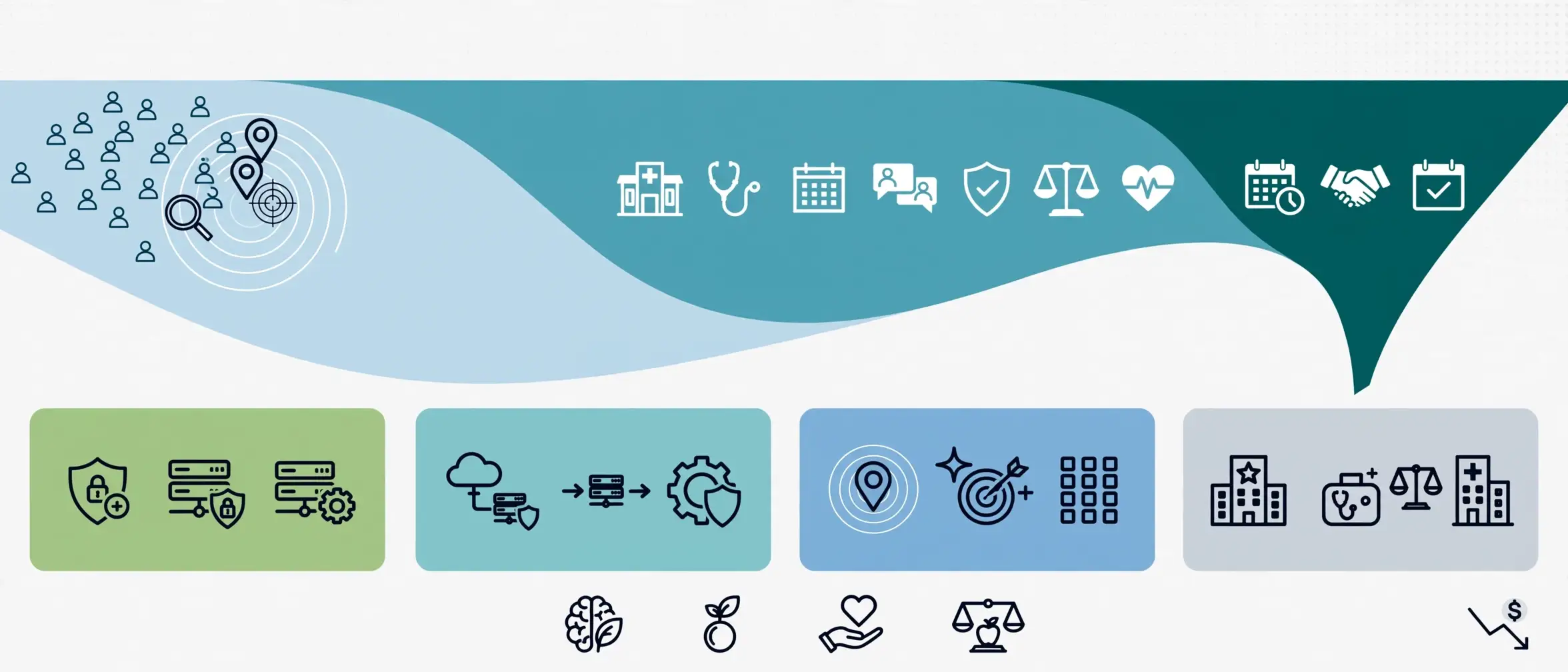
High-performing healthcare paid search campaign structures:
- Branded search campaigns: Capture patients searching specifically for your practice name – highest intent, lowest CPC, non-negotiable in competitive markets
- Specialty service campaigns: Non-branded keywords for your specific service lines (e.g., “orthopedic surgeon [city],” “physical therapy near me,” “cardiologist accepting new patients”)
- Competitor campaigns: Carefully structured campaigns targeting patients searching for competing practices – ethically framed around your differentiators
- Appointment and booking intent campaigns: Keywords that explicitly signal booking intent (“book appointment,” “schedule consultation,” “new patient appointment”)
Patient acquisition cost benchmarks by specialty:
| Specialty | Average Patient Acquisition Cost 2026 |
|---|---|
| Urgent Care | $40 – $80 |
| Pediatrics | $155 – $200 |
| Primary Care | $150 – $250 |
| Physical Therapy | $200 – $350 |
| Mental Health / Behavioral Health | $300 – $600+ |
| Orthopedics | $350 – $500 |
| Cosmetic Surgery | $400 – $610 |
| Behavioral Health (complex) | $600 – $2,500+ |
Source: patientprism.com and emulent.com 2026 healthcare marketing benchmarks
Appointment Booking Conversion Optimization
The appointment booking experience is the single most underleveraged conversion asset in most healthcare marketing programs. Driving qualified patients to a website is only half the work – converting that traffic into booked appointments requires deliberate friction reduction.
Booking conversion optimization principles:
- Online booking is mandatory: Patients increasingly expect self-service scheduling. Practices without online booking lose a significant share of potential patients who will not call during office hours
- Reduce form fields: Every unnecessary field on an appointment request form reduces completion rates. Collect only what is needed to route and prepare for the appointment; gather clinical history through the patient intake process, not the marketing funnel
- Display wait time and availability: Showing approximate availability reduces abandonment from patients uncertain about access timelines
- Mobile-first booking experience: 78% of patients use search engines to find healthcare providers, predominantly on mobile devices. Booking pages that are not mobile-optimized produce significantly lower conversion rates
- Click-to-call integration: For patients who prefer phone contact, click-to-call functionality on mobile pages captures this conversion intent without requiring form completion
Patient Retention: The Highest-ROI Healthcare Marketing Activity
Retaining an existing patient is dramatically less expensive than acquiring a new one. Telehealth patients show 40% higher lifetime value when properly acquired and retained through targeted marketing, according to direction.com research.
HIPAA-compliant patient retention tactics:
- Preventive care reminder campaigns: Annual wellness visit reminders, vaccination schedule updates, and screening reminders sent through HIPAA-compliant automated communication platforms
- Post-visit follow-up sequences: 48-hour post-appointment satisfaction checks (through HIPAA-compliant SMS or email), 30-day check-ins for ongoing care patients, and treatment milestone communications
- Health education newsletters: Monthly or quarterly health education content sent to opted-in patient email lists – general health topics appropriate to your specialty, not personalized health condition content
- Birthday and milestone messages: Non-clinical acknowledgment messages that maintain relationship without PHI use
Full Funnel Healthcare Marketing: Channel Comparison Table
| Channel | Funnel Stage | Compliance Risk | Cost Profile | Patient Acquisition Strength |
|---|---|---|---|---|
| Healthcare SEO | TOFU / MOFU | Low | Low cost, high time | Very high (long-term) |
| Google Ads (Search) | BOFU | Medium (pixel risk) | High CPC | Very high (short-term) |
| Google Display / YouTube | TOFU | Low-Medium | Medium CPM | High (awareness) |
| Connected TV (CTV) | TOFU | Low | Medium CPM | High (local brand) |
| Email Nurture (BAA) | MOFU / Retention | High (requires BAA) | Low cost | High (retention) |
| Social Media Organic | MOFU | Medium (content risk) | Low cost, high time | Medium |
| Meta Ads (Health) | TOFU / MOFU | High (pixel, audience) | Medium CPC | Medium (restricted) |
| Online Reviews / ORM | MOFU / BOFU | Medium (response risk) | Low cost | Very high (trust) |
| Healthcare Directories | MOFU / BOFU | Low | Low-Medium | High (specialty) |
| Patient Referral Program | MOFU / Retention | Low | Low cost | Very high (LTV) |
Step-by-Step: Building a HIPAA-Compliant Full Funnel Healthcare Marketing Strategy


Step 1: Complete a HIPAA Marketing Compliance Audit
Before launching any new marketing program, audit your current digital footprint for compliance risks:
- Identify every third-party tracking pixel on your website and document which pages they are deployed on
- Review which pages contain PHI-adjacent content (appointment confirmation, patient portal access, condition-specific service pages)
- Audit your vendor stack: which marketing tools currently handle patient data and do they all have signed BAAs?
- Review your advertising accounts for any custom audience uploads that may contain PHI
Step 2: Establish Your BAA-Covered Technology Infrastructure
Identify and contract with compliant versions of every marketing tool you need:
- HIPAA-compliant CRM with BAA: HubSpot (with BAA signed for relevant products), Salesforce Health Cloud, or healthcare-specific CRM platforms
- HIPAA-compliant email marketing: Platforms that offer BAAs include Mailchimp (Business/Enterprise), Constant Contact (with BAA), and healthcare-specific platforms like LuxSci
- HIPAA-compliant analytics: Matomo On-Premise, or Google Analytics 4 configured with PHI filtering and a BAA where available
- HIPAA-compliant scheduling: Athenahealth, Zocdoc, or similar scheduling platforms with established BAA infrastructure
Step 3: Build Your Healthcare Content Architecture
Map your content plan to the patient awareness ladder:
- Identify the top 10 to 15 health conditions and procedures relevant to your specialty
- Create pillar content pages for each: comprehensive, clinically reviewed condition education pages that establish category authority
- Build supporting blog content around the specific questions patients ask at each awareness stage
- Develop a video content library with physician-narrated condition explanations for YouTube and your website
Step 4: Optimize Your Local Search and Reputation Presence
- Claim and fully complete your Google Business Profile for every practice location
- Audit your presence on Healthgrades, Zocdoc, Vitals, WebMD, and relevant specialty directories
- Implement a systematic post-visit review request process using a HIPAA-compliant messaging platform
- Establish a review response protocol that addresses all reviews within 48 hours without disclosing PHI
Step 5: Configure Compliant Paid Media Campaigns
- Build your Google Ads account structure around branded, specialty service, and appointment-intent keyword clusters
- Configure server-side conversion tracking with PHI filtering before deploying any tracking on booking confirmation pages
- Remove or restrict Meta Pixel from condition-specific and appointment-confirmation pages
- Set up Google Ads conversion tracking using Enhanced Conversions with compliant data handling
Step 6: Build Your Nurture Infrastructure
- Create segmented email lists from explicit opt-in sources (website health newsletter sign-ups, event registrations, content downloads)
- Develop a 5-email welcome and education nurture sequence for each primary audience segment
- Configure HIPAA-compliant appointment reminder and post-visit follow-up automations
- Set up a patient satisfaction survey process connected to your review request workflow
Step 7: Establish Patient Acquisition Cost Tracking
Connect marketing spend to patient acquisition outcomes:
- Define the specific conversion events you track: form submission, phone call, booked appointment, first-visit completed patient
- Configure call tracking with HIPAA-compliant call recording if using phone as a conversion channel
- Calculate CAC by channel monthly: total marketing investment divided by new patients acquired from that channel
- Set a target CAC by specialty based on average patient lifetime value to establish sustainable budget parameters
Common Healthcare Marketing Mistakes That Violate HIPAA and Waste Budget
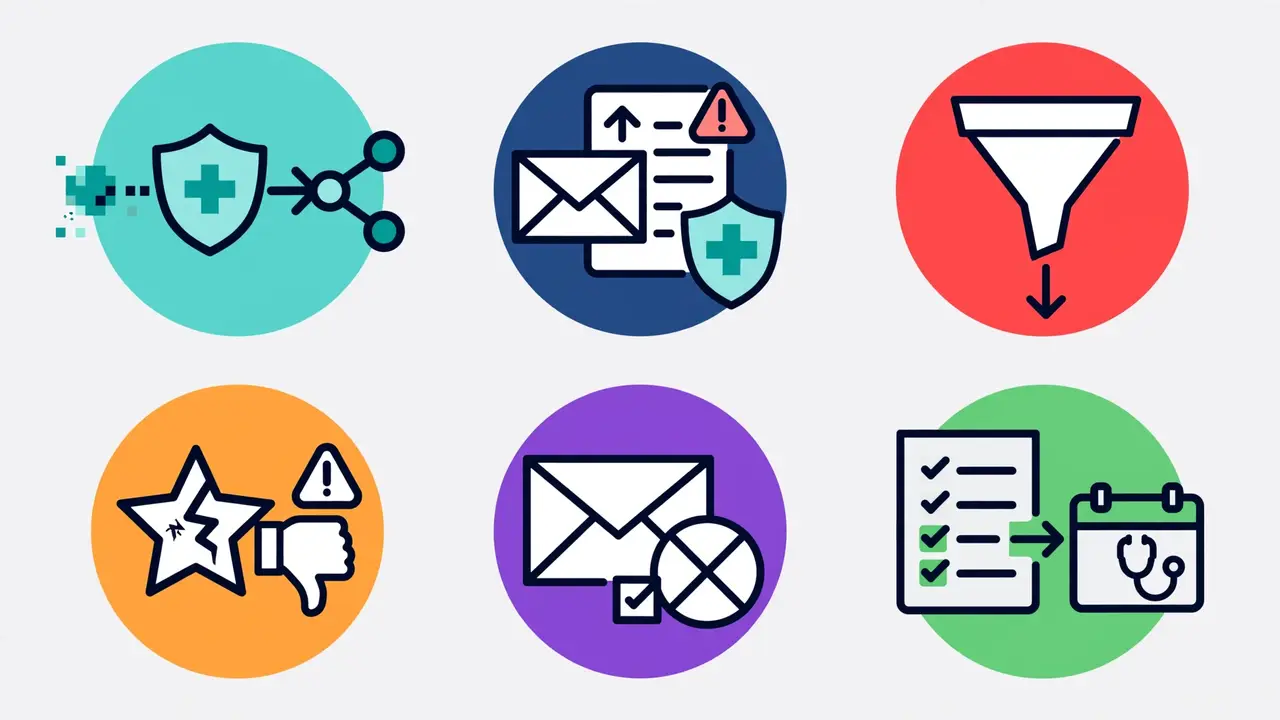
Mistake 1: Using the Meta Pixel on Appointment Confirmation Pages
This is one of the most widespread HIPAA compliance errors in healthcare marketing. The Meta Pixel on a booking confirmation page transmits the fact of an appointment to Meta without a BAA – which constitutes PHI transmission. Meta’s 2025 policy changes now proactively scan for this type of data. The fix: implement server-side pixel management with PHI-stripped event data, or remove the pixel from confirmation pages entirely.
Mistake 2: Uploading Patient Email Lists to Ad Platforms Without PHI Review
Patient email lists uploaded to Google Customer Match or Meta Custom Audiences as part of lookalike audience creation can constitute PHI transmission if the list is associated with health condition or treatment data. Every patient list uploaded to an ad platform must be reviewed to ensure it contains only contact information entirely disconnected from health condition data.
Mistake 3: Investing Only in Bottom-of-Funnel Paid Search
Practices that allocate 90% of their marketing budget to Google Search conversion campaigns compete intensively for the small fraction of the patient population actively searching for a provider right now. This produces high CPCs, volatile pipeline volume, and zero brand equity investment. Shifting 30% to 40% of budget toward top-of-funnel awareness content (SEO, YouTube, CTV) builds a compounding pipeline that reduces average patient acquisition cost over time.
Mistake 4: Ignoring Online Review Management
With 79% of patients reading reviews before choosing a provider and 55% having walked away from a doctor based on online reviews (prnewswire.com, 2026), ignoring review management is one of the most expensive passive mistakes a healthcare practice can make. A single unaddressed negative review from six months ago can cost dozens of unconverted patient inquiries.
Mistake 5: Sending Non-Consented Marketing Emails to Patient Lists
Healthcare practices sometimes attempt to re-engage inactive patients or cross-sell services by sending marketing emails to clinical patient lists without explicit marketing consent. Under HIPAA and CAN-SPAM, this practice is both legally risky and operationally counterproductive. Patient clinical records are not marketing lists. Marketing communications require explicit, separately obtained opt-in consent.
Mistake 6: Measuring Success by Leads Instead of Acquired Patients
Healthcare marketing is ultimately measured by new patients who completed a first appointment – not form fills, phone calls, or demo requests. Practices that optimize for lead volume without tracking the lead-to-booked-appointment-to-completed-visit conversion chain frequently discover that their lowest-CPC campaigns are generating the lowest-quality patient inquiries.
Expert Tips for High-Performance Healthcare Marketing
Tip 1: Make physician personal brands your primary TOFU investment
Physician thought leadership on LinkedIn, YouTube, and health publications builds patient trust at a scale that no amount of branded advertising can replicate. Patients are 4 times more likely to trust content from individual clinicians than branded practice content. A physician with a consistent content presence builds referral networks, media relationships, and patient familiarity simultaneously.
Tip 2: Use condition-specific landing pages rather than general homepages for paid traffic
Patients searching for “knee replacement surgeon in [city]” who arrive at a general practice homepage experience a relevance gap that reduces conversion rates significantly. Build dedicated landing pages for every high-value service line that mirror the specific intent of the search query, include relevant clinical credentialing, and present a frictionless appointment booking option.
Tip 3: Implement call tracking with HIPAA-compliant platforms
Phone calls represent a significant but frequently untracked conversion channel in healthcare marketing. HIPAA-compliant call tracking platforms (with BAAs) allow you to attribute phone appointment bookings to their originating marketing channel – closing the attribution gap that causes many healthcare organizations to undervalue their SEO and organic content investment.
Tip 4: Build a structured patient referral program
Word-of-mouth referrals remain among the highest-quality patient acquisition sources in healthcare, yet most practices manage this entirely informally. A structured program – with clear incentive structures for referring patients, a simple referral process, and thank-you communications through HIPAA-compliant channels – transforms an unmanaged organic dynamic into a measurable acquisition channel.
Tip 5: Align content to the specific AI search queries your patients use
47% of patients now use AI tools to research healthcare providers. AI assistants like ChatGPT, Perplexity, and Google’s AI Overview surface content from well-structured, clinically authoritative, long-form health education pages. Optimizing your content for AI citation – clear question-and-answer formatting, structured data markup, and clinician attribution – creates a TOFU presence in the AI search layer that traditional SEO alone does not address.
Measuring Full-Funnel Healthcare Marketing Performance

Top-of-Funnel Healthcare Marketing Metrics
- Organic search impressions and clicks for condition and procedure keywords
- Website sessions from organic, display, and CTV channels
- YouTube video view rates and watch time on health education content
- Google Business Profile views and search appearances
- Branded search volume growth month-over-month
Middle-of-Funnel Healthcare Marketing Metrics
- Review platform star rating average and review volume growth
- Email nurture sequence open rate (benchmark: 37% to 41%) and click-through rate (benchmark: ~2.7%)
- Directory profile click-throughs and appointment requests
- Social media follower growth and engagement rate on health education content
- Returning visitor rate on health education content
Bottom-of-Funnel Healthcare Marketing Metrics
- Appointment request form completion rate
- Phone call volume from tracked marketing channels
- Booked appointment rate from all inquiry channels
- Patient acquisition cost by channel and by specialty
- New patient first-visit completion rate (booked appointment to attended appointment)
- Patient lifetime value by acquisition channel
FAQ: Full-Funnel Marketing Healthcare
Q1: What is full funnel marketing in healthcare?
Full funnel marketing healthcare is a coordinated, multi-stage patient acquisition and retention system that applies distinct marketing strategies at every stage of the patient journey – from initial health awareness through provider selection, appointment booking, first visit, and ongoing care retention. Unlike single-stage marketing approaches that focus only on active appointment-seekers, full funnel healthcare marketing invests in building brand awareness, provider credibility, and patient trust before active search intent develops – capturing patients earlier in their decision journey and reducing cost per acquisition over time.
Q2: How does HIPAA affect healthcare marketing?
HIPAA’s Privacy Rule prohibits using Protected Health Information (PHI) for marketing purposes without explicit patient authorization. In practical digital marketing terms, this means healthcare organizations cannot use patient condition data to target advertising, cannot upload clinical patient lists to ad platforms, must sign Business Associate Agreements with every vendor that handles PHI, and must remove third-party tracking pixels (Meta Pixel, Google Analytics) from pages where PHI is present – including appointment confirmation pages and patient portal interfaces.
Q3: What is a Business Associate Agreement and why does it matter for healthcare marketing?
A Business Associate Agreement (BAA) is a legally required contract between a healthcare covered entity and any vendor that creates, receives, maintains, or transmits PHI on its behalf. In healthcare marketing, this includes CRM platforms that store patient contact and health data, email marketing platforms used for patient communications, analytics tools that track behavior on PHI-adjacent pages, and appointment scheduling software. Operating marketing tools that handle PHI without a signed BAA exposes the healthcare organization to HIPAA penalties ranging from $100 to $50,000 per violation incident.
Q4: What are the best marketing channels for healthcare patient acquisition?
The highest-performing patient acquisition channels in healthcare are: Google Search Ads for bottom-of-funnel appointment intent capture; healthcare SEO and educational content for long-term top-of-funnel organic pipeline; online reputation management and review generation for middle-of-funnel trust building; and HIPAA-compliant email nurture for existing patient retention and reactivation. Each channel serves a different funnel stage and should be evaluated against stage-appropriate metrics rather than a single conversion metric applied uniformly across all channels.
Q5: How much does patient acquisition cost in healthcare?
Patient acquisition cost in healthcare varies dramatically by specialty: from approximately $40 to $80 for urgent care, $150 to $250 for primary care and pediatrics, $200 to $500 for physical therapy and orthopedics, and $600 to $2,500 or more for complex behavioral health and specialty surgical care. The appropriate patient acquisition cost target for any practice is determined by average patient lifetime value – a practice where the average patient generates $3,000 in lifetime revenue can sustainably invest significantly more in acquisition than one where the average patient generates $400.
Q6: Can healthcare providers use Meta Ads for patient acquisition?
Healthcare providers can use Meta Ads for awareness and consideration-stage advertising, but with significant compliance constraints. Meta’s 2025 policy changes restrict the use of custom audiences that reference health conditions or protected attributes. Healthcare advertisers must not use the Meta Pixel on appointment confirmation or patient portal pages, must not upload patient lists as custom audiences without PHI review, and must configure any retargeting campaigns to use broad behavioral signals rather than condition-specific page visit data. Awareness campaigns using geographic and general demographic targeting remain viable for brand-building purposes.
Q7: How do you measure the ROI of full-funnel healthcare marketing?
Healthcare marketing ROI is measured by connecting channel investment to new patient acquisition volume and patient lifetime value. The formula is: (New Patients Acquired × Average Patient Lifetime Value) – Total Marketing Investment, divided by Total Marketing Investment, multiplied by 100. Healthcare marketing campaigns average a 3.62:1 ROI overall, with channel-specific ratios ranging from 2:1 to 12:1 depending on specialty and attribution accuracy, according to improvado.io hospital marketing benchmarks. Top-of-funnel brand investment should be measured through branded search volume growth and direct traffic trends, while bottom-of-funnel campaigns are measured by cost per booked appointment.
Q8: What content types work best for full funnel marketing in healthcare?
At the top of the funnel, educational content works best: condition explanation articles, procedure guides, symptom-checker tools, health awareness videos, and physician thought leadership. In the middle of the funnel, trust-building content drives consideration: patient testimonials (with consent), physician credential showcases, before-and-after outcome stories, FAQ pages addressing common patient concerns, and comparison content explaining care approaches. At the bottom of the funnel, conversion-enabling content closes the loop: appointment booking pages with clear availability, insurance acceptance information, new patient welcome guides, and FAQ content addressing practical access questions.
Healthcare Marketing That Earns Trust Before It Asks for an Appointment
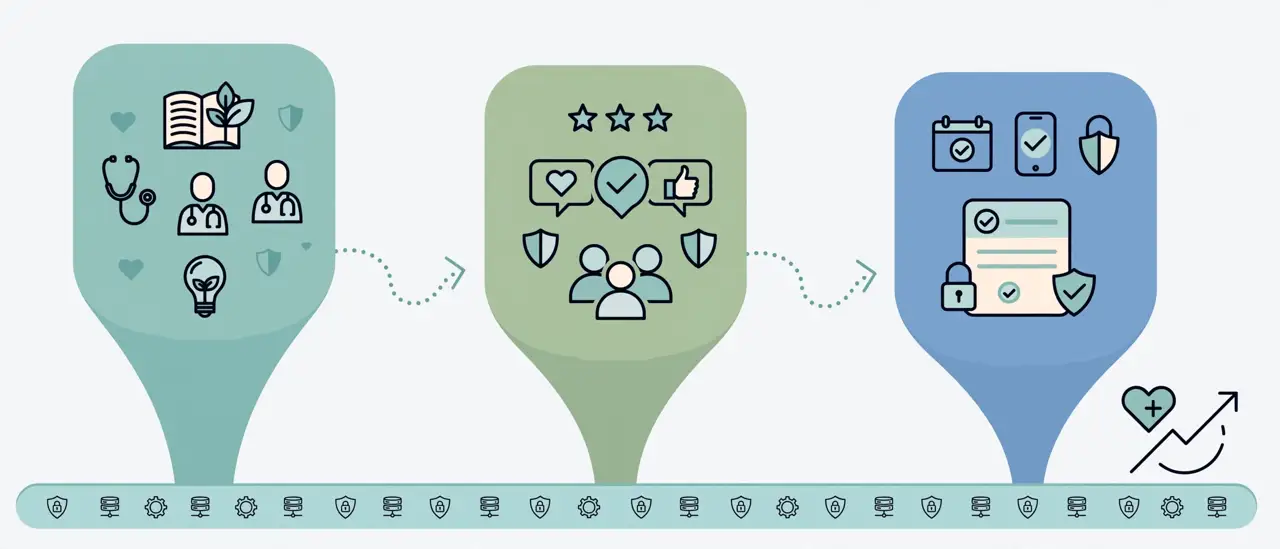
The most sustainable patient acquisition strategy in healthcare is one that earns a patient’s trust long before they are ready to book. Full funnel marketing healthcare builds that trust systematically – through clinically credible content at the top of the funnel, reputation and social proof in the middle, and a frictionless, compliant booking experience at the bottom.
Healthcare organizations that invest exclusively in bottom-of-funnel paid search are competing in the most expensive, most competitive segment of the patient acquisition market. Every dollar spent on health education content, physician thought leadership, and online reputation management reduces the cost of every bottom-of-funnel conversion by building the brand familiarity that makes conversion more likely when search intent finally activates.
HIPAA compliance is not the obstacle that many healthcare marketers treat it as. It is the framework that, when understood and implemented correctly, actually creates competitive advantage. Healthcare organizations with clean, compliant data infrastructure can measure attribution accurately, run more effective campaigns, and build patient relationships that retain and refer – while competitors who cut compliance corners accumulate both legal risk and the data quality problems that corrupt every marketing decision downstream.
The five principles to carry forward:
- Build your full funnel marketing healthcare strategy outward from HIPAA compliance – not as an afterthought, but as the operational foundation that every channel and tool decision is made against
- Invest in the 90% of your addressable patient market that is not in active search right now through educational content, physician authority, and review management
- Sign BAAs with every marketing vendor that touches patient data before running a single compliant campaign through that tool
- Remove third-party tracking pixels from appointment confirmation and patient portal pages immediately – this is the single most urgent compliance action for most healthcare marketing operations
- Measure patient acquisition cost by specialty and channel, and connect that figure to patient lifetime value to establish sustainable budget parameters across your full-funnel program
Ready to build a full-funnel patient acquisition system that drives measurable growth while staying fully HIPAA-compliant? Connect with the revenue-focused marketing specialists at BRMIS to design a healthcare marketing strategy that maps every channel investment to verified patient acquisition outcomes – from first impression to first appointment to long-term patient relationship.