
AI full funnel marketing automation refers to the use of autonomous AI agents to plan, execute, and optimize marketing activities across every stage of the customer journey – from awareness to retention – without constant manual intervention. Unlike traditional automation tools that follow fixed rules, these agents make real-time decisions using live data, adjusting targeting, content, and spend as conditions change. This shift is moving marketing teams away from siloed, channel-by-channel management toward a single, coordinated system that runs the entire funnel.


Marketing teams have spent the last decade stitching together dozens of point solutions – one tool for email, another for ads, a third for analytics – and hoping the data lines up. It rarely does. That patchwork approach is exactly what full-funnel marketing services were built to fix, and AI agents are now the engine making that coordination possible at scale.
In this article, we’ll break down what AI full funnel marketing automation actually looks like in practice, where it delivers the most value, the mistakes teams commonly make when adopting it, and how to evaluate whether your organization is ready for it.
What Is AI Full Funnel Marketing Automation?
AI full funnel marketing automation is the practice of deploying AI agents that manage marketing tasks continuously across the top, middle, and bottom of the funnel – rather than automating isolated tasks within a single channel.
Traditional marketing automation (think: email drip sequences or scheduled social posts) follows a predetermined script. If a lead doesn’t respond to email three, the workflow simply moves them to email four. It doesn’t ask why, and it doesn’t adapt.

AI agents work differently. They:
- Continuously ingest performance data across channels
- Identify patterns a human analyst might take days to spot
- Make and execute decisions – reallocating budget, adjusting copy, pausing underperforming assets – often within minutes
- Learn from outcomes and refine future decisions accordingly
This distinction between rule-based automation and agentic decision-making is the core of what makes the current wave of AI marketing tools fundamentally different from the marketing automation platforms of the 2010s.
Why Full-Funnel Coordination Matters More Than Channel Optimization
Optimizing a single channel in isolation – say, improving Facebook ad click-through rate – can actually hurt overall funnel performance if it isn’t coordinated with what happens next. A campaign that drives cheap clicks but attracts unqualified leads simply shifts cost further down the funnel, onto the sales team.

Full-funnel thinking treats the customer journey as one connected system. Consequently, AI agents that operate across the entire funnel can make trade-offs a single-channel tool never could, such as intentionally accepting a higher cost-per-click in exchange for leads that convert at a meaningfully higher rate.
The Three Layers of the Funnel AI Agents Now Manage
| Funnel Stage | Traditional Approach | AI Agent Approach |
|---|---|---|
| Top (Awareness) | Manual audience segmentation, scheduled ad creative rotation | Real-time audience discovery, dynamic creative generation and testing |
| Middle (Consideration) | Static lead scoring models, generic nurture sequences | Behavioral scoring updated per interaction, personalized content sequencing |
| Bottom (Conversion/Retention) | Fixed follow-up cadences, manual sales handoff | Predictive intent signals, automated handoff timing, churn-risk detection |
How AI Agents Actually Execute Marketing Tasks
Understanding the mechanics helps demystify what’s often marketed as a black box. Here’s a practical breakdown.
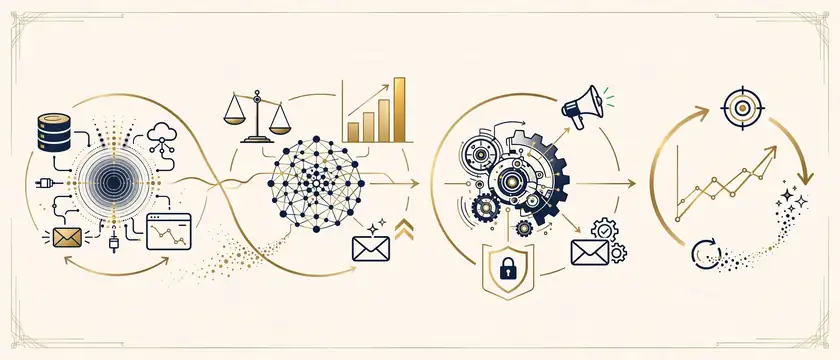
1. Data Ingestion and Signal Detection
AI agents pull from CRM records, ad platform APIs, website analytics, and email engagement data simultaneously. Rather than waiting for a weekly report, the agent detects shifts – a sudden drop in conversion rate on a landing page, for instance – as they happen.
2. Decision-Making Through Predictive Models
Once a signal is detected, the agent references trained models to decide what action best serves the campaign’s objective. This might mean shifting budget from an underperforming ad set to a stronger one, or triggering a different email sequence for a segment showing high purchase intent.
3. Autonomous Execution
This is where AI full funnel marketing automation diverges most sharply from earlier tools. The agent doesn’t just recommend an action in a dashboard for a human to approve later – it executes the change directly through connected platforms, subject to guardrails set by the marketing team.
4. Continuous Feedback and Refinement
Every executed action produces an outcome, and that outcome becomes training data for the next decision. Over time, this feedback loop is what allows agents to improve targeting precision and creative performance without a human rewriting the rules each week.
Practical Applications Across the Funnel
Top-of-Funnel: Audience Discovery and Creative Testing
AI agents can generate and test dozens of ad creative variations simultaneously, then reallocate spend toward winning combinations within hours rather than the weeks a manual A/B test would require. They also surface new audience segments by identifying patterns among converting users that a human strategist might not think to test.

Middle-of-Funnel: Dynamic Lead Nurturing
Instead of every lead receiving the same five-email sequence, agents assemble a nurture path based on individual behavior – what pages someone visited, how long they engaged, which content they downloaded. This behavioral personalization consistently outperforms static sequences because it responds to actual intent signals rather than assumed ones.
Bottom-of-Funnel: Conversion and Retention
At the conversion stage, agents can flag high-intent leads for immediate sales follow-up, time outreach to match a prospect’s engagement window, and identify at-risk accounts before churn happens – often by detecting subtle drops in product usage or support ticket sentiment.
Common Mistakes When Adopting AI Full Funnel Marketing Automation
Even well-resourced teams stumble during adoption. Some of the most frequent missteps include:
- Automating a broken process. If your funnel already has structural problems – unclear positioning, a weak offer – AI agents will simply execute that broken process faster.
- Removing all human oversight too early. Guardrails matter. Teams that hand over full autonomy before the agent has proven itself in a given context often see brand voice inconsistencies or targeting drift.
- Ignoring data quality. Agents are only as good as the data feeding them. Fragmented tracking or unreliable attribution will produce confidently wrong decisions.
- Treating it as a one-time setup. AI full funnel marketing automation requires ongoing calibration; goals, offers, and audiences shift, and the agent’s guardrails need to shift with them.
- Skipping the change management step. Marketing teams that don’t clearly define who reviews agent decisions and how often tend to lose trust in the system when something inevitably goes sideways.
Expert Tips for a Smooth Rollout
- Start with one funnel stage rather than automating everything at once, so you can validate results before expanding scope.
- Set explicit spend and messaging guardrails before granting execution authority.
- Maintain a human-in-the-loop review cadence for at least the first 60-90 days.
- Audit your data pipeline and attribution setup before deployment; garbage in, garbage out applies doubly to autonomous systems.
- Document decision logic the agent surfaces, so your team can spot when its reasoning starts to drift from strategic intent.
Step-by-Step: How to Implement AI Full Funnel Marketing Automation
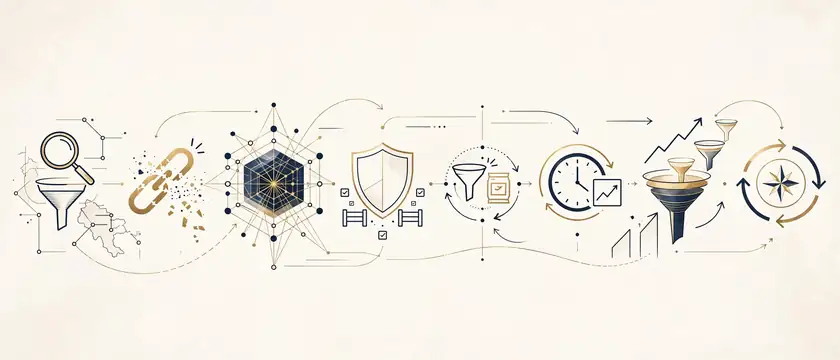
- Audit your current funnel. Map every touchpoint from first ad impression to post-purchase retention, and identify where data currently breaks or goes untracked.
- Consolidate your data sources. Ensure your CRM, ad platforms, and analytics tools can feed a unified data layer; agents can’t coordinate decisions on fragmented data.
- Define clear objectives and guardrails. Specify what the agent is optimizing for (pipeline value, not just clicks) and what it’s not allowed to do without approval.
- Pilot on a single segment or channel. Choose a contained use case, such as retargeting ads for one product line, before expanding funnel-wide.
- Review outcomes weekly during the pilot. Compare agent-driven results against your previous baseline, and adjust guardrails based on what you observe.
- Scale gradually across funnel stages. Expand the agent’s scope only once it has demonstrated consistent, explainable decision-making.
- Reassess quarterly. Objectives, offers, and market conditions change; your automation guardrails should be revisited on the same cadence as your broader marketing strategy.
AI Full Funnel Marketing Automation vs. Traditional Marketing Automation
| Factor | Traditional Marketing Automation | AI Full Funnel Marketing Automation |
|---|---|---|
| Decision logic | Fixed rules set in advance | Adapts based on live data and outcomes |
| Scope | Usually single-channel | Coordinated across the entire funnel |
| Response time | Hours to weeks (manual review cycles) | Minutes to hours |
| Personalization | Segment-based | Individual behavioral signals |
| Maintenance | Set-and-forget until manually updated | Requires ongoing calibration and oversight |
| Best suited for | Predictable, repetitive workflows | Dynamic environments with shifting demand signals |
Quick Answer: Is AI Full Funnel Marketing Automation Right for Your Business?

It tends to deliver the strongest ROI for businesses with enough transaction or lead volume to generate meaningful behavioral data, and enough channel complexity that manual coordination has become a genuine bottleneck. Smaller operations with a handful of leads per week generally see less benefit, since there isn’t enough signal for the agent to learn from efficiently.
Frequently Asked Questions
What is AI full funnel marketing automation?
It’s the use of autonomous AI agents to manage marketing activities across the entire customer journey – awareness, consideration, and conversion – making and executing data-driven decisions in real time rather than following fixed, pre-set rules.
How is this different from regular marketing automation software?
Traditional tools execute predefined workflows without adapting. AI full funnel marketing automation involves agents that analyze live performance data and adjust targeting, creative, and spend autonomously, based on what’s actually working.
Do AI marketing agents replace the need for a marketing team?
No. They handle repetitive execution and data analysis at a speed humans can’t match, but strategic direction, brand judgment, and guardrail-setting still require human oversight, particularly during the first several months of deployment.
What data do AI agents need to work effectively?
At minimum, connected CRM data, ad platform performance data, and website or product analytics. Fragmented or untracked data significantly limits how well an agent can coordinate decisions across the funnel.
How long does it take to see results from AI full funnel marketing automation?
Most teams begin seeing measurable shifts in efficiency within 30-60 days of a well-scoped pilot, though full-funnel coordination benefits typically compound over two to three months as the agent accumulates more outcome data.
Is AI full funnel marketing automation safe for brand consistency?
It can be, provided clear guardrails around tone, messaging, and approved creative assets are set before granting execution authority, along with a regular human review cadence.
Conclusion
AI full funnel marketing automation isn’t about replacing marketers – it’s about closing the gap between the volume of data modern marketing generates and the speed at which humans can act on it. Teams that treat this shift as an ongoing capability rather than a one-time software purchase are the ones seeing compounding returns across their funnel.
If you’re evaluating whether your team has the infrastructure and strategy in place to make this shift, partnering with a full-funnel marketing agency that has already navigated this transition can shortcut months of trial and error.