
The full funnel marketing definition refers to an integrated, multi-stage demand architecture that aligns brand-building, demand generation, mid-funnel nurture, and performance-driven conversion into a single, continuously measured revenue system. Rather than treating top-of-funnel awareness and bottom-of-funnel acquisition as siloed budget lines with separate owners, full-funnel marketing synchronises creative strategy, audience data, attribution modelling, and sales enablement across every touchpoint in the buyer journey. The output is a compounding growth engine where each funnel stage – awareness, consideration, conversion, and retention – feeds measurable signal into the next, closing the loop between brand equity and revenue performance.
Teams that want that engine designed, launched, and managed under one roof work with BRMIS’s full-funnel marketing and growth services – a specialist practice that unifies media planning, multi-touch attribution, lifecycle automation, and pipeline reporting into one operating model. The sections below give you the practitioner-level breakdown that turns the definition into action.
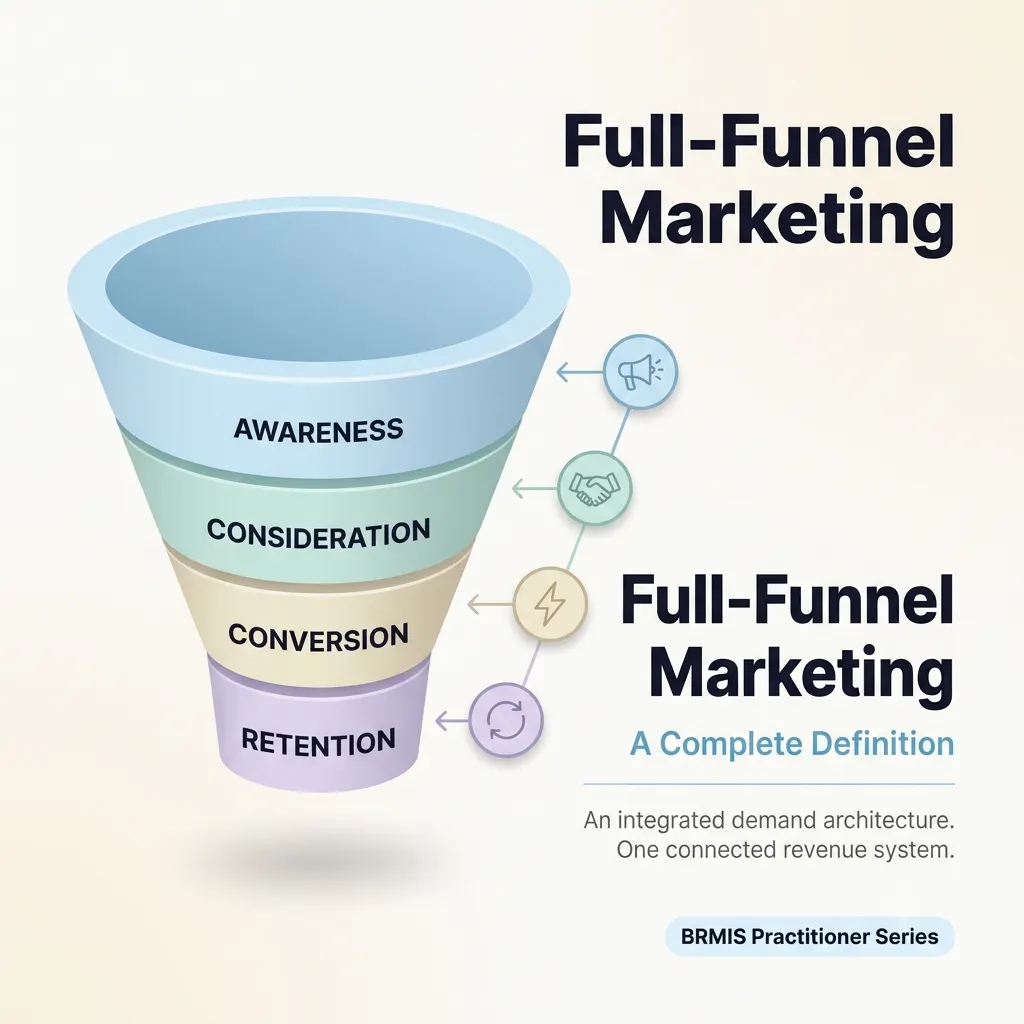
What the Full Funnel Marketing Definition Actually Covers
Most marketers can sketch a funnel on a whiteboard. Far fewer can describe how every stage connects, feeds one another, and ultimately drives revenue. That gap is exactly where the full funnel marketing definition does its real work.
At the operational level, full-funnel marketing means three things simultaneously:
- Coverage: Your brand is present at every meaningful stage of the buyer’s journey, not just the final mile.
- Continuity: Messaging, creative, and data carry a coherent story as a prospect moves from discovery to decision.
- Connected measurement: A single attribution model evaluates awareness, engagement, and conversion together, so no stage steals credit from another.
Quick definition for reference: Full-funnel marketing is a strategy that creates purpose-built content, media, and experiences for every stage of the customer journey – from initial problem awareness through purchase and post-sale advocacy – and measures their collective contribution to revenue in one integrated system.
Think with Google research consistently finds that brands combining upper- and lower-funnel investment outperform those concentrating spend at the bottom, both in short-term sales lift and long-term market share. (Content was rephrased for compliance with licensing restrictions.)
The distinction matters because most organisations default to last-click thinking. They fund what is easy to measure – branded paid search, retargeting, direct response – and starve the awareness and consideration layers that create the demand those bottom-funnel channels then claim credit for. A genuine full funnel marketing definition, applied in practice, corrects that structural imbalance.
The Four Stages of the Funnel: TOFU, MOFU, BOFU, and Retention
Understanding the full funnel marketing definition requires a clear picture of what each stage is actually responsible for. Here is the breakdown practitioners use.
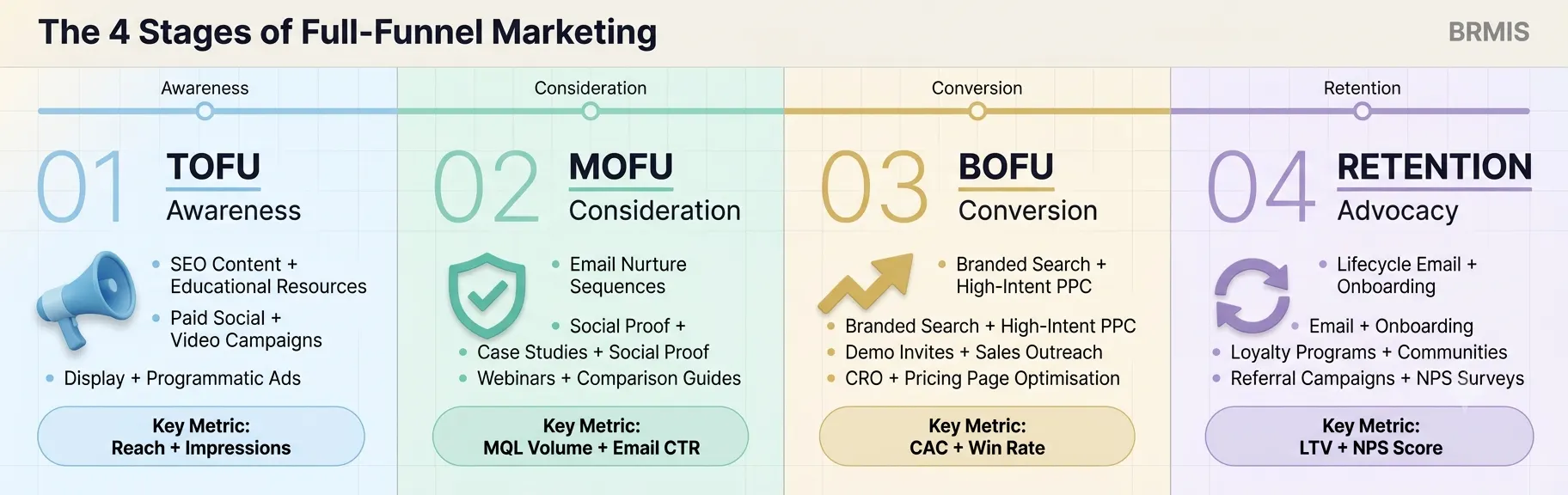
Top of the Funnel (TOFU): Earning Attention
TOFU is where you reach people who do not yet know you exist. Your job here is not to sell; it is to surface your brand at the moment a prospect first recognises they have a problem worth solving.
Primary goal: Reach and educate net-new audiences.
Typical channels and tactics:
- SEO-driven blog content and educational resources
- Organic and paid social (awareness campaigns, video, reels)
- Display advertising, programmatic, and YouTube pre-roll
- Podcast sponsorships and thought-leadership PR
- Influencer partnerships at the macro or niche level
What to measure at TOFU:
- Reach and unique impressions
- Branded search volume lift (pre/post)
- Share of voice in target categories
- Net-new website visitors from non-branded queries
A common trap at this stage is judging awareness content by direct conversions. Doing so kills the exact programs that fill the pipeline further down. For a deeper look at building awareness that converts downstream, see how a structured content strategy for the top of the funnel complements paid reach.
Middle of the Funnel (MOFU): Building Trust and Preference
MOFU is where a prospect knows they have a problem and is now evaluating options. Your brand is in consideration – but so are your competitors. The mission here is to demonstrate expertise, reduce perceived risk, and build enough trust that the prospect leans toward you.
Primary goal: Nurture intent and establish preference.
Typical channels and tactics:
- Email nurture sequences and marketing automation
- Gated content: whitepapers, webinars, calculators, comparison guides
- Case studies and social proof assets
- Mid-funnel retargeting with educational creative
- SEO content targeting “best X for Y” and comparison queries
What to measure at MOFU:
- Email open and click-through rates
- Content download and webinar registration rates
- Marketing qualified leads (MQLs) and lead quality scores
- Return visitor rates and multi-session engagement
- Time-on-site for key decision-stage pages
Understanding the difference between nurturing intent and generating net-new demand is critical at this stage. Our breakdown of demand generation versus lead nurturing unpacks that distinction in full.
Bottom of the Funnel (BOFU): Driving the Decision
At BOFU, intent is high. The prospect has self-qualified; they know what they need and are deciding who provides it. Your job now is to remove friction, not to educate.
Primary goal: Convert qualified demand into revenue.
Typical channels and tactics:
- Branded and non-branded paid search (high-intent queries)
- Personalised sales outreach and demo invitations
- Free trials, product tours, and limited-time offers
- Competitive displacement content and objection-handling assets
- Pricing pages, live chat, and conversion rate optimisation (CRO)
What to measure at BOFU:
- Conversion rate by channel and audience segment
- Customer acquisition cost (CAC)
- Sales qualified leads (SQLs) and pipeline value
- Win rate and average deal size
- Time to close
An important nuance: BOFU channels like branded search largely capture demand that TOFU and MOFU programs created. When attribution is last-click only, these channels appear to generate all the value. In reality, they are harvesting it.
Post-Purchase: Retention, Expansion, and Advocacy
Modern full-funnel marketing definitions treat post-purchase as a fourth stage, not an afterthought. Retaining a customer costs significantly less than acquiring a new one, and loyal customers reduce blended CAC by generating referrals and organic word-of-mouth.
Primary goal: Maximise lifetime value (LTV) and activate advocates.
Typical channels and tactics:
- Onboarding email sequences and in-product guidance
- Loyalty programmes and exclusive customer communities
- NPS surveys and proactive customer success outreach
- Upsell and cross-sell lifecycle campaigns
- Referral programmes and affiliate incentives
What to measure post-purchase:
- Churn rate and retention rate
- Customer lifetime value (LTV) and LTV:CAC ratio
- NPS and CSAT scores
- Repeat purchase rate and expansion revenue
- Referral rate and organic brand mentions
Full-Funnel vs. Single-Channel Marketing: A Direct Comparison
| Dimension | Full-Funnel Marketing | Single-Channel / Last-Click |
|---|---|---|
| Primary KPI | Revenue, pipeline velocity, LTV | Clicks or last-click conversions |
| Budget logic | Allocated across all funnel stages | Concentrated at BOFU |
| Attribution model | Multi-touch or data-driven | Last-click only |
| Team structure | Marketing and sales aligned on one revenue goal | Siloed by channel or tactic |
| Messaging continuity | Consistent narrative across the journey | Disconnected creative per campaign |
| Measurement frequency | Ongoing, cross-stage reporting | Campaign-level only |
| Growth pattern | Compounding and durable | Short-term spikes; rising CAC over time |
| Customer experience | Coherent and personalised | Fragmented and repetitive |
| Risk profile | Diversified across channels | Over-reliant on one channel or keyword cluster |
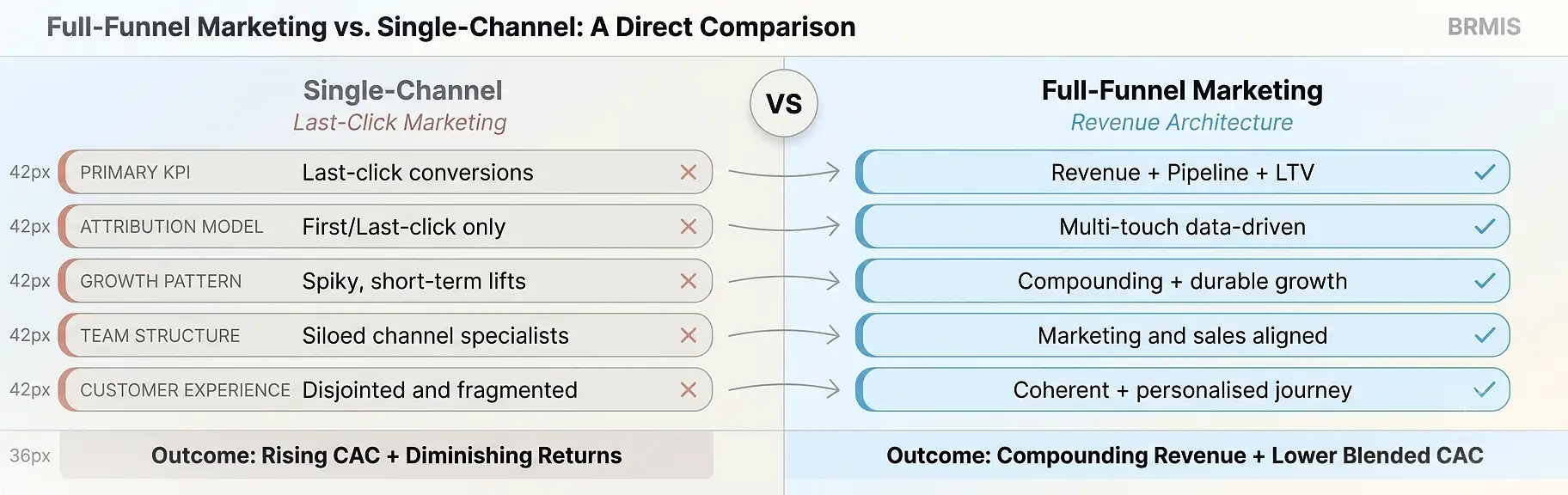
McKinsey research on full-funnel strategy found that organisations combining brand-building with performance marketing through linked teams and shared KPIs consistently outperform those running them separately – in both sales lift and market share growth. (Content was rephrased for compliance with licensing restrictions.)
How to Build a Full-Funnel Marketing Strategy: Step by Step
The 8-Step Full-Funnel Build Framework
- Map the real buyer journey. Interview recent customers and your sales team. Document the actual path from problem recognition to purchase, noting the questions prospects ask at each stage.
- Audit your current coverage. Plot existing content, campaigns, and channels against the four funnel stages. Most teams discover they are heavily weighted toward BOFU with almost nothing at MOFU.
- Define your ICP and audience segments. A full-funnel strategy only works with the right people at each stage. Develop detailed Ideal Customer Profile (ICP) criteria and segment by intent level.
- Fix the measurement layer first. Implement clean UTM tracking, a reliable CRM pipeline, and a multi-touch attribution model before scaling any spend. Building a funnel on broken data is the single most expensive mistake in digital marketing.
- Set stage-specific KPIs and targets. Assign awareness goals to TOFU, MQL goals to MOFU, CAC and conversion goals to BOFU, and LTV and retention goals post-purchase.
- Build connected creative assets. Ensure a prospect who encounters your brand at TOFU and then again at BOFU experiences a coherent story, not two unrelated campaigns.
- Allocate budget across all stages deliberately. A commonly cited starting benchmark is a 60/25/15 split: roughly 60% toward awareness and consideration, 25% toward conversion, and 15% toward retention. Adjust based on your growth stage.
- Establish a review cadence and reallocate. Review the full funnel monthly, not just individual campaign results. Move budget toward the stages generating the most compounding downstream impact.
Practitioner note: Teams that fix attribution before scaling spend consistently report lower effective CAC within two quarters – not because they spend less, but because they stop funding channels that look good in last-click models while contributing nothing to real pipeline.
KPIs and Metrics by Funnel Stage
| Funnel Stage | Core Question | Key Metrics | Common Mistake |
|---|---|---|---|
| TOFU (Awareness) | Did we reach the right people? | Impressions, reach, branded search lift, share of voice, new visitors | Measuring TOFU by last-click conversions |
| MOFU (Consideration) | Are they engaging and trusting us? | Email CTR, MQL volume, content downloads, return visits, engagement rate | Counting all leads equally regardless of intent |
| BOFU (Conversion) | Are they choosing us? | Conversion rate, CAC, SQL volume, win rate, deal size | Over-weighting this stage in attribution |
| Post-Purchase (Retention) | Are they staying, expanding, and referring? | Churn rate, LTV, LTV:CAC ratio, NPS, repeat purchase rate | Treating the sale as the finish line |
For teams selecting and benchmarking these metrics, understanding how to build a multi-touch attribution model for your funnel is the critical next step.
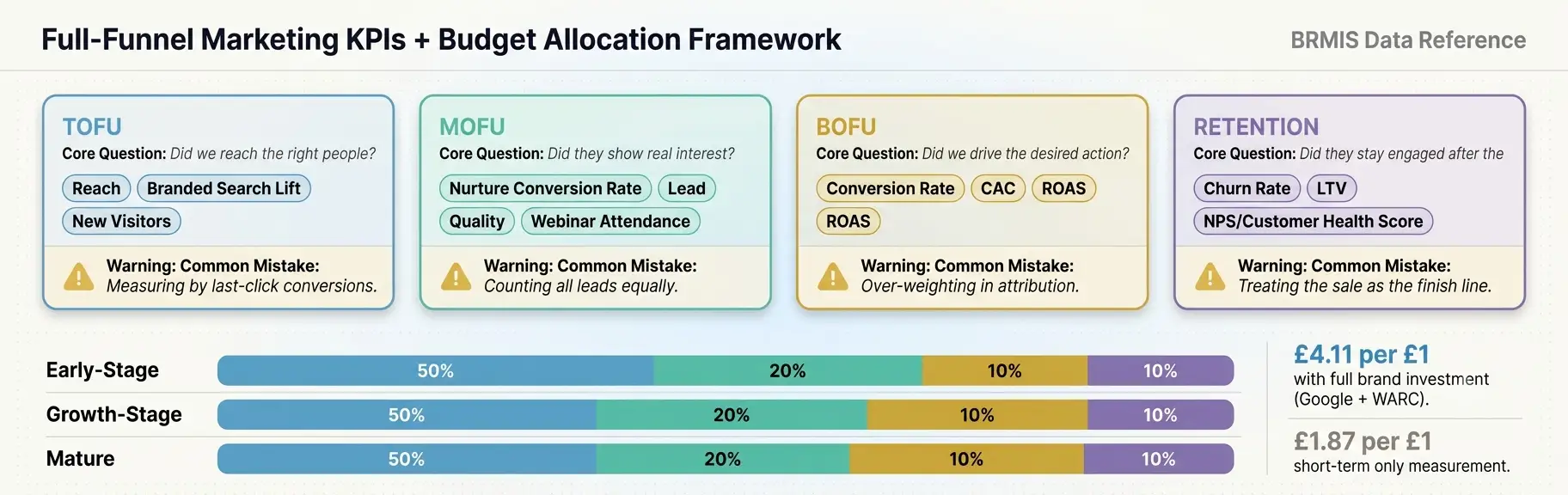
Budget Allocation Across the Funnel
| Business Stage | TOFU | MOFU | BOFU | Retention |
|---|---|---|---|---|
| Early-stage / pre-PMF | 50% | 25% | 20% | 5% |
| Growth-stage | 40% | 25% | 25% | 10% |
| Mature / market leader | 35% | 20% | 25% | 20% |
Research from Google and WARC’s Effectiveness Equation work found that measuring only short-term ROI returns roughly £1.87 per £1 spent; accounting for sustained brand-building effects of the same investment returns £4.11 per £1. In practical terms, protecting awareness spend more than doubles the effective long-run return.
For additional context on how a specialist full-funnel marketing agency structures media investment across these stages, that resource covers channel sequencing and budget review processes in operational detail.
Common Full-Funnel Marketing Mistakes to Avoid
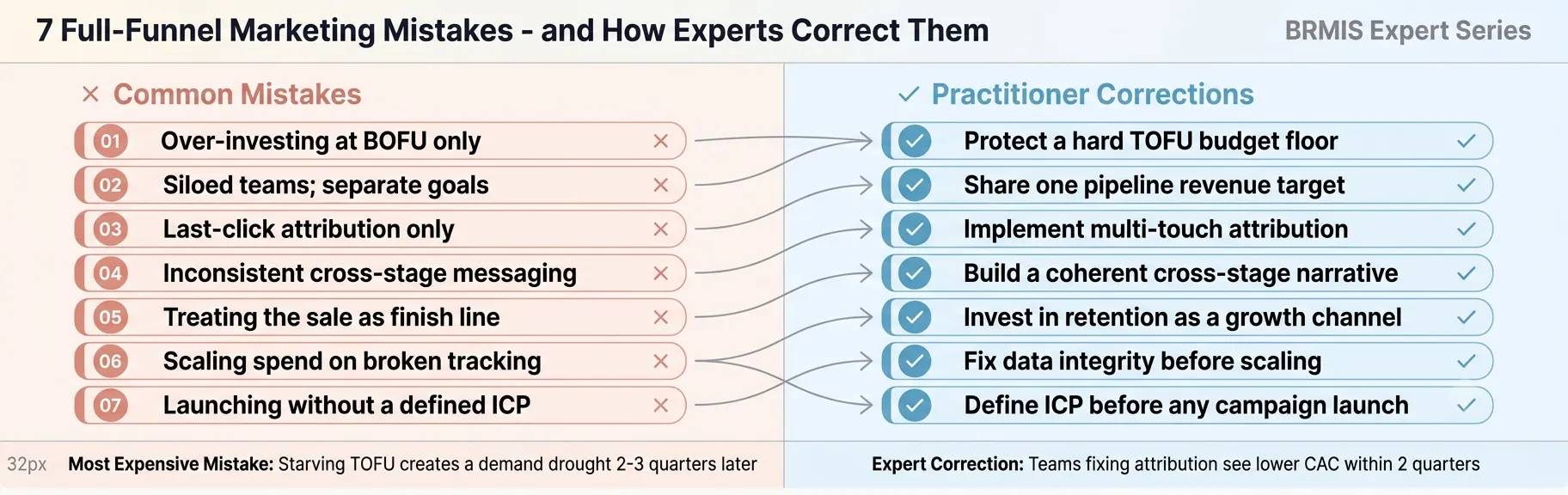
Mistake 1: Over-Investing at the Bottom of the Funnel
When the top of the funnel runs dry, conversion campaigns have no one left to convert. CAC rises, performance teams demand more budget, and the cycle repeats. A hard floor on TOFU and MOFU spend – protected even under quarterly pressure – breaks that cycle.
Mistake 2: Running Siloed Teams with Separate Goals
When marketing is accountable only for MQLs and sales only for closed deals, the handoff becomes a blame zone. Aligning both teams on one pipeline revenue number eliminates that friction immediately.
Mistake 3: Relying Exclusively on Last-Click Attribution
Last-click attribution systematically undervalues awareness and consideration touchpoints. Over time, it creates a feedback loop that starves the stages doing the most work in the buyer journey.
Mistake 4: Inconsistent Messaging Across Stages
A prospect who hears three different brand stories across three stages trusts none of them. Creative should evolve in sophistication as a buyer deepens into the funnel, but the core narrative must remain coherent throughout.
Mistake 5: Treating the First Sale as the Finish Line
Ignoring the post-purchase stage quietly inflates CAC because all growth falls on new acquisition. Retention programmes extend customer value and reduce the acquisition workload on every other funnel stage.
Mistake 6: Scaling Spend on Broken Tracking
Adding budget to a funnel with faulty attribution does not solve the measurement problem; it multiplies it. Fix data integrity before increasing investment.
Mistake 7: Launching Without a Defined ICP
Running full-funnel campaigns to a poorly defined audience wastes spend at every stage simultaneously. Tight ICP criteria and audience segmentation are foundational, not optional.
Expert Tips from Full-Funnel Practitioners
- Lock in a brand investment floor. Agree with leadership on a minimum percentage of budget reserved for upper-funnel work and protect it in every quarterly review.
- Report on assisted conversions alongside last-click. Show stakeholders how TOFU and MOFU touchpoints contributed to eventually closed deals. Visualising assisted conversion paths challenges the false narrative that only bottom-funnel channels produce results.
- Sync on one revenue number. When marketing and sales share a single pipeline target and attribution system, the inter-team friction that slows most organisations disappears entirely.
- Refresh creative by stage, not all at once. Ad fatigue hits different funnel stages at different rates. Monitor frequency and engagement by stage independently, then rotate creative for whichever layer shows decline first.
- Feed closed-won and closed-lost data back into targeting. Use sales outcome data to sharpen audience models at TOFU and MOFU. Closed-won profiles inform lookalike audiences; closed-lost patterns inform exclusion lists.
- Treat retention as a growth channel, not a cost centre. Quantify referral volume and its contribution to pipeline. When advocacy is measured, it gets invested in; when ignored, it withers.
- Run quarterly funnel health reviews. Analyse conversion rates at every stage transition. A drop in any single transition rate pinpoints exactly where the system needs attention.
Explore more frameworks like these in our roundup of growth marketing playbooks used by high-performing teams.
Frequently Asked Questions
What is the full funnel marketing definition in simple terms?
The full funnel marketing definition describes an approach where brands create connected content, media, and experiences for every stage of the customer journey: awareness (TOFU), consideration (MOFU), conversion (BOFU), and post-purchase retention. Each stage is measured as part of one revenue system, not in isolation.
How is full-funnel marketing different from performance marketing?
Performance marketing typically optimises for bottom-of-funnel conversions in isolation, relying on last-click attribution. Full-funnel marketing includes performance media but connects it to brand and demand-generation activity above the funnel, measuring all stages together. The result is lower long-run CAC and more predictable pipeline.
What are the main stages in a full marketing funnel?
The four stages are: Top of Funnel (TOFU) for awareness, Middle of Funnel (MOFU) for consideration and nurturing, Bottom of Funnel (BOFU) for conversion, and post-purchase for retention and advocacy. Modern full funnel marketing definitions consistently treat retention as a fourth, revenue-compounding stage rather than an afterthought.
Why does the full funnel marketing definition matter for ROI?
Because last-click attribution fundamentally misrepresents where value is created in the buyer journey. Research from Google and WARC found that accounting for brand-building effects more than doubles the measured return on marketing spend compared to short-term-only measurement. Full-funnel thinking aligns budget with where value is actually generated, not just where it is easiest to count.
Is full-funnel marketing only relevant for large businesses?
No. The principles apply at any budget level. Being present at every journey stage, maintaining message continuity, and measuring across the whole system are achievable with modest budgets when channels are chosen strategically. A tight ICP, clean tracking, and a consistent content calendar deliver meaningful full-funnel coverage even for early-stage businesses.
How do you measure success using the full funnel marketing definition framework?
Measure success with stage-specific KPIs tied to one shared revenue goal: reach and branded search lift at TOFU; MQL volume and engagement rate at MOFU; CAC, conversion rate, and win rate at BOFU; and LTV, churn rate, and NPS post-purchase. The system is healthy when every stage transition rate is improving and blended CAC is declining quarter over quarter.
What is the biggest mistake teams make when applying the full funnel marketing definition?
The most expensive mistake is over-investing at the bottom of the funnel while neglecting awareness and consideration. This creates a demand drought that forces ever-increasing BOFU spend to maintain the same pipeline volume. Protecting upper-funnel investment – even under performance pressure – is the discipline that separates durable revenue growth from costly short-term spikes.
From Full Funnel Marketing Definition to Measurable Revenue
The full funnel marketing definition is ultimately about one thing: connection. Connecting brand investment to performance outcomes. Connecting awareness to consideration to conversion to retention. Connecting every marketing activity to the revenue number that actually determines business success.
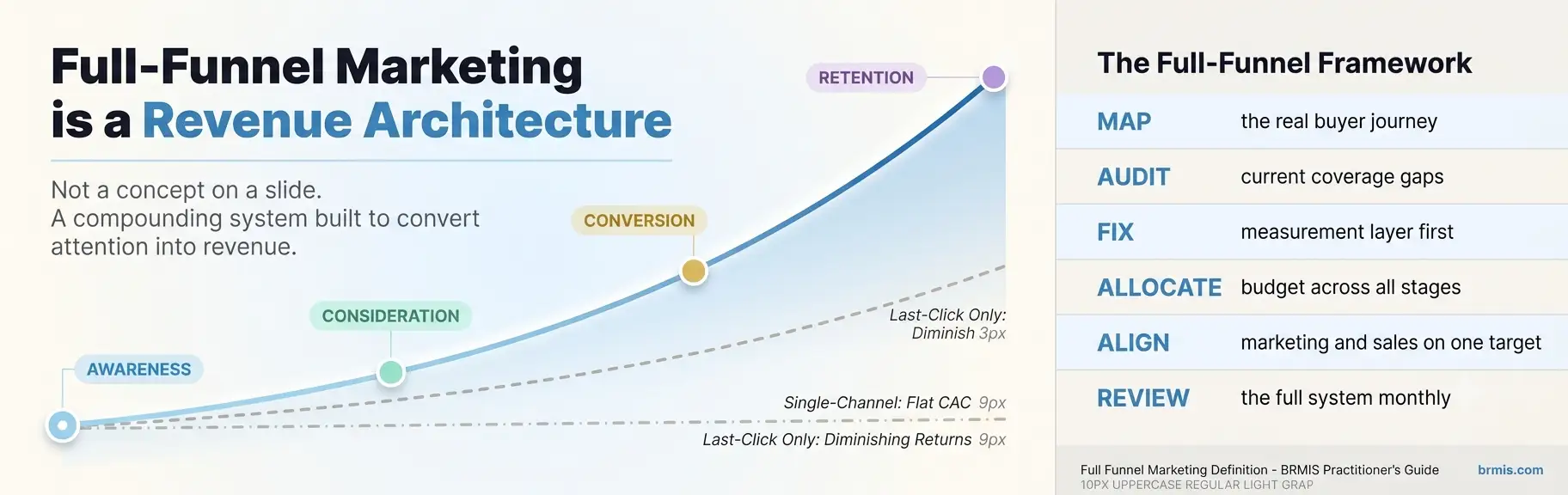
Organisations that apply this definition in practice – with clean measurement, stage-specific budgets, aligned teams, and consistent creative – consistently outperform those running disconnected, last-click-driven campaigns. They build compounding demand rather than buying the same leads over and over at increasing cost.
The framework is clear:
- Map the real buyer journey before building any campaign.
- Audit your current coverage and identify the gaps (almost always MOFU).
- Fix the measurement layer before scaling any spend.
- Allocate budget deliberately across all four stages – and protect it.
- Align marketing and sales on a single pipeline revenue target.
- Review the full system, not just individual channels, on a fixed cadence.
That is the full funnel marketing definition at work: not a concept on a slide, but an operational architecture that turns attention into revenue.
When you are ready to build that architecture with a team that has delivered it across industries and business stages, start your full-funnel revenue strategy with BRMIS and get a connected funnel engineered to compound.